Decarbonizing Western Canada’s transportation sector

Edmonton Global recently commissioned Deloitte to complete an assessment on the state of hydrogen adoption in the commercial transportation sector in Western Canada. The purpose of the assessment was to understand the current state and provide some actionable opportunities to scale the adoption of hydrogen in this sector. The results have been published in a report entitled, “Zero Emission Vehicle Awareness Initiative - Current State Assessment.”

This article will provide a summary of the report which was completed with funding from Natural Resources Canada as part of its Zero Emissions Vehicle Awareness Initiative. This initiative aims to increase awareness of the hydrogen opportunity for Western Canada’s commercial transportation sector.

Key findings

Overall, the report highlights three key findings:

  1. Hydrogen vehicles are better suited for long-haul heavy-duty trucking than Battery Electric.  
  2. Fleet operators prioritize the total cost of ownership when making vehicle purchasing decisions.
  3. The Edmonton Region is Alberta’s most strategic location for hydrogen vehicle adoption.

Hydrogen vehicles are better suited for long-haul heavy-duty trucking than Battery Electric  

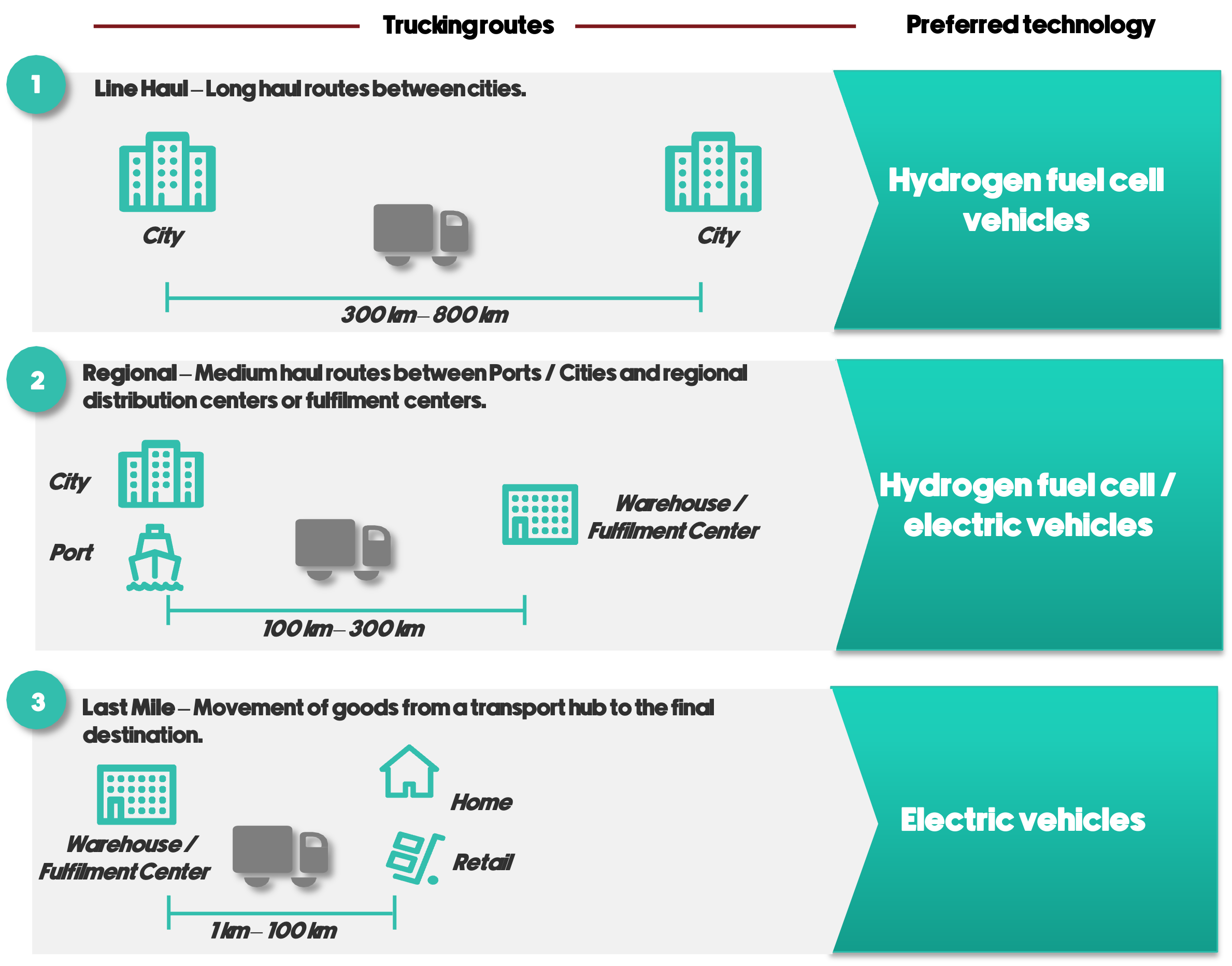
The report acknowledges that many pathways are needed to decarbonize commercial transportation. However, while battery electric vehicles may make sense for some applications, like light-duty short-haul trucking, hydrogen-powered vehicles must be at the heart of decarbonizing the commercial transport sector. This is largely due to the extended range and performance over long distances, while carrying heavy loads, and in extreme weather conditions.
Fuel cell electric vehicles (FCEV)

The report goes on to say that Fuel Cell Electric Vehicles offer significant potential for long-haul trucking because they have similar fueling times, range, and performance as traditional internal combustion engine vehicles.

Dual-fuel technology

The report further identifies dual-fuel technology as serving an important bridge technology that will allow fleets to more nimbly and affordably decarbonize their existing fleets by retrofitting them with this technology.  

How truck purchasing decisions are made

According to the report, fleet operators consider the total cost of ownership (TCO), which includes energy costs, subsidies, and maintenance. Fuel prices, how long a vehicle is owned, and how far it’s driven influence total cost of ownership the most. This reinforces the need to consider strategies that will support lowering hydrogen fuel costs. Notably, fuel costs are projected to reach competitive levels as the infrastructure and supply chain develop. The report also notes that federal and provincial grants and incentives that address the TCO of hydrogen vehicles can play a significant role in reducing costs, making hydrogen technology a more affordable and attractive choice.

While TCO is the leading factor, it is one of many criteria. Reliability and performance, brand reputation, weight regulations, and customer support are also key drivers influencing fleet owners’ purchasing decisions. Together, these factors shape purchasing decisions for fleet operators.

The Edmonton Region is the most strategic location for hydrogen vehicle adoption  

The report identified strategic trucking corridors that should be prioritized for fuel station development. The recommendations were based on location, access to fuel, and potential for hydrogen vehicle pilots. Developing these stations will be critical in ensuring reliable hydrogen supply for long-haul trucks.

A map of the united statesDescription automatically generated

Edmonton to Calgary  

Edmonton to Calgary was identified as the highest impact strategic route with Highway 2 having some of the highest truck traffic in the province. Spanning 300 km, this route presents opportunities for investments in fueling stations within and between both regions.  

There is one permanent commercial hydrogen fueling station already in place in the Edmonton Region, along with several temporary stations. In April 2024, Air Products announced its plans to open a multi-modal hydrogen fueling station at its Edmonton facility and create a “hydrogen highway” of refueling stations between the Edmonton Region and Calgary by 2025.  

Edmonton to Prince George

Edmonton to Prince George via Highway 16 is another key route with potential opportunity. The report suggests building a fueling station in Hinton, Alberta to connect the two hydrogen hubs.

Edmonton to Fort McMurray  

High trucking volumes along the Edmonton to Fort McMurray corridor, covering 450 km one-way, is a strong indicator of the need for hydrogen refueling stations.

British Columbia

In British Columbia, the Lower Mainland and Prince George were identified as the most strategic regions for fueling station development. Currently, Vancouver and Prince George have collectively announced their ambitions to produce approximately 400 tonnes of hydrogen per day, which will undoubtedly spur investment into hydrogen fueling infrastructure.
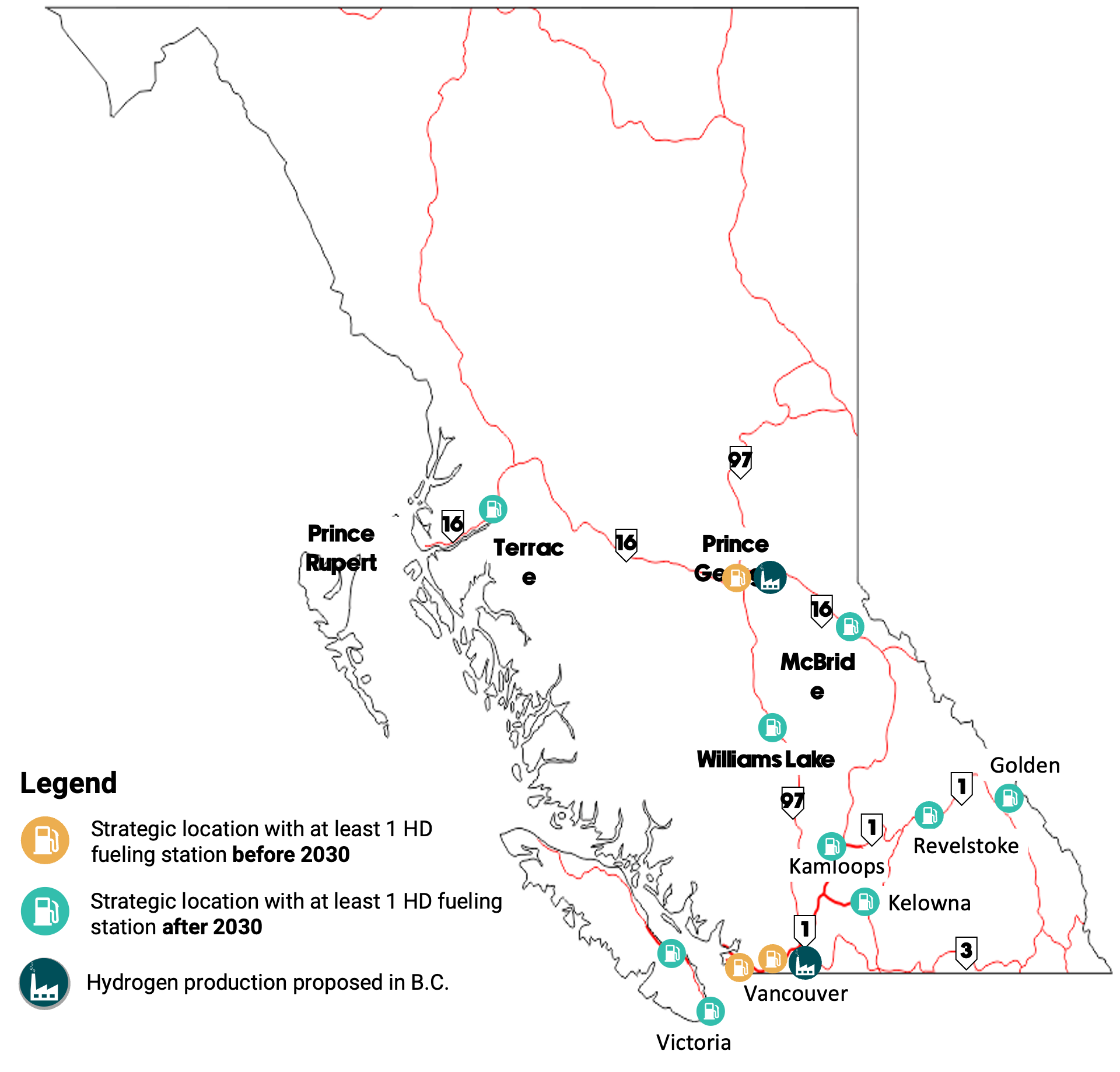
HTEC plans to open a heavy-duty, higher capacity, fueling station located on Tsawwassen First Nation land near Vancouver. HTEC also has a proposed clean hydrogen facility which is expected to support the deployment of up to 30,000 fuel cell vehicles.

Hydra Energy plans to open the first commercial fueling station in Prince George with on-site hydrogen production. The company also has plans to open a low-carbon hydrogen production facility and commercial fueling station in 2024, on the same site.  

Conclusion

Canada’s entire hydrogen value chain, including fleet operators, service and technology providers, manufacturers, refueling station operators, and hydrogen producers all have a role to play in decarbonizing our future.  

The Edmonton Region’s hydrogen ecosystem holds strategic importance in decarbonizing the commercial transportation sector — particularly for Class 8 trucks and buses for long-haul and heavy-haul transportation. With hydrogen-powered vehicles becoming more commercially available for wide-scale deployment, the Calgary to Edmonton corridor, Alberta’s busiest highway, stands as a key starting point to develop a scalable hydrogen refueling network across Western Canada. 

Interested in learning more? Download the official report here.

latest articles

Teaming up to advance dual-fuel engine technology

January 27, 2026
Originally published by University of Alberta. See original post here.

U of A partnership with City of Edmonton and Diesel Tech Industries will boost research and training aimed at reducing emissions from city vehicles.

January 27, 2026 By Geoff McMaster

The University of Alberta is teaming up with the City of Edmonton and Diesel Tech Industries (DTI) to reduce carbon emissions from the city’s fleet of diesel-powered buses by integrating hydrogen fuel into combustion engines.

If successful, the project will provide vehicle operators across Canada with a retrofit solution to immediately reduce their carbon footprint without replacing existing fleets, says David Gordon, co-principal investigator along with Bob Koch, both professors in the Department of Mechanical Engineering.

Examining both hydrogen-diesel dual fuel combustion and 100 per cent hydrogen combustion, researchers in the U of A’s Mechanical Engineering Energy Control Lab will explore ways to increase hydrogen-to-diesel fuel replacement. They will develop new control strategies to handle the higher combustion temperatures from burning hydrogen, and investigate the operating range and potential emission benefits of these engines.

“We’re also investing in the next generation of clean-tech leaders,” says Gordon. “Engineers-in-training will have the opportunity to conduct hands-on research and write their theses on hydrogen-diesel dual-fuel technology.”

Leveraging the U of A’s extensive experience with machine learning control and diagnostics, DTI will produce retrofit kits for Edmonton’s bus fleet that can then be sold to operators across Canada to help them transition to carbon-free transportation, all consistent with the goals of Alberta’s Hydrogen Roadmap.

The collaborative project is funded through an NSERC Alliance partnership with the City of Edmonton and by an Emissions Reduction Alberta grant.

Register

Canada’s hydrogen economy is coming together

February 3, 2026

Canada’s hydrogen hubs are coordinating for scale and resilience

Canada’s hydrogen economy is unifying in a new era of collaboration, with the Edmonton region playing a key role in creating national connections.

Rather than advancing hydrogen development in isolation, Canada’s regional hubs are aligning their strengths through the Pan-Canadian Alliance of Hydrogen Hubs. The Alliance brings together hubs from Alberta, British Columbia, Quebec and Atlantic Canada to strengthen coordination, close gaps across the value chain and support a more resilient, made-in-Canada hydrogen economy.

For the Edmonton Region Hydrogen Hub, the Alliance reinforces our region’s role as a foundation of Canada’s hydrogen economy. The region brings scale, cost competitiveness and industrial experience that support the transition from pilot projects to commercial deployment.

Together, each participating hub offers unique strengths toward the national ecosystem:

  • The Edmonton region provides access to affordable natural gas, carbon capture and storage, and large industrial demand and a strategic node for commercial transportation, enabling low-emission hydrogen production at commercial scale and early end-use adoption.
  • British Columbia, through the SFU Clean Hydrogen Hub, contributes advanced research, systems analysis and policy expertise, supporting technology development and clean energy integration.
  • Quebec’s Energy Transition Valley brings leadership in renewable electricity, green hydrogen production and system integration, strengthening efficiency and industrial design.
  • Newfoundland, through Memorial University, adds export-oriented potential, supported by large-scale renewable resources and proximity to European markets.
  • The Atlantic Hydrogen Alliance contributes port infrastructure, logistics expertise and trade connectivity, helping link domestic production to global markets.

By working together, the hubs reduce duplication, accelerate learning and improve Canada’s ability to develop domestic technologies while attracting investment.

“Collaboration is key to unlocking the full potential of the hydrogen economy and ensuring broad economic and environmental benefits,” said Brent Lakeman, Executive Director of the Edmonton Region Hydrogen Hub. “This alliance allows Canada to build a competitive hydrogen industry that reflects the strengths of Canada as a whole.”

Stronger coordination across regions creates the conditions needed to move projects forward and sustain momentum in a rapidly evolving global energy landscape.

Canada is coming together

As regions across the country work to address gaps in Canada’s hydrogen economy, the need for collaboration is becoming a common theme. This Spring, leaders in industry, government and innovation have an opportunity to continue that momentum – and address the biggest challenges facing Canada’s clean energy economy – at the 2026 Canadian Hydrogen Convention. The conference is where the future of clean energy takes shape, and where key partnerships will define what’s next.

The 2026 Canadian Hydrogen Convention takes place April 21st to 23rd in Edmonton. Register today to learn more about the Alliance and discover new opportunities in Canada’s hydrogen economy at North America’s largest conference dedicated to hydrogen.

Register

Edmonton Region Hydrogen Hub joins Pan-Canadian Alliance of Hydrogen Hubs to accelerate clean energy innovation

October 1, 2025

This release was originally published by La Vallée de la Transition Énergétique (VTE)

Trois-Rivières, October 1, 2025, PRESS RELEASE – Valléede la Transition Énergétique (VTE), today announced the official launch of the Pan-Canadian Alliance of Hydrogen Hubs, in collaboration with three national partners: Simon Fraser University's Clean Hydrogen Hub (British Columbia), the Newfoundland and Labrador Hydrogen Innovation Partnership (Newfoundland and Labrador), and the Edmonton Regional Hydrogen Hub (Alberta).

This strategic alliance marks a major milestone for Canada in the development of a clean hydrogen ecosystem that is driving the transition to a net-zero economy. By joining forces with complementary regional hubs, the alliance aims to stimulate investment, support technological innovation, foster workforce training, and ensure long-term energy security and sustainability.


"VTE is proud to play a leading role in this pan-Canadian initiative. Hydrogen is an essential lever for decarbonization, and this national collaboration allows us to showcase Québec's expertise while strengthening our leadership in the clean-energy sector," said Alain Lemieux, Executive Director of VTE.


The four partners have signed a Memorandum of Understanding formalizing their commitment to work together on common goals, including:

  • Support for the development of hydrogen-related projects in each region.
  • Promotion and commercialization of Canadian hydrogen technologies.
  • Collaboration on training, education and community outreach.
  • Sharing knowledge and best practices at the technical, economic and financial levels.


A partnership rooted in action and innovation

Launched in a context where the federal government is focusing on clean energy nation-building projects, including major initiatives in wind and hydrogen, the Pan-Canadian Alliance of Hydrogen Hubs is part of an ambitious vision of a Canada as a world leader in sustainable energy.

Green hydrogen, produced by electrolysis from water and renewable electricity, is a clean and versatile energy solution, with applications in transport, heavy industry and the production of synthetic fuels such as methanol or ammonia.

International reach already underway

In 2025, alliance partners participated in a Transatlantic Hydrogen Hubs Dialogue to strengthen collaboration between Canada and Germany on hydrogen infrastructure development. This initiative also supports the Canada–Germany Hydrogen Alliance, backed by Natural Resources Canada, and paves the way for transatlantic hydrogen hubs.

VTE intends to play a central role in positioning Québec –and Canada – as a leader in the hydrogen economy on a global scale.

Quotes:

"VTE is proud to play a leading role in this pan-Canadian initiative. Hydrogen is a key lever for decarbonization, and this national collaboration showcases Québec's expertise while strengthening our leadership in the clean-energy sector."

Alain Lemieux, CEO, Vallée de la Transition Énergétique (VTE)

"Hydrogen represents a transformative opportunity for Canada to decarbonize its economy — from production to end-use. Hydrogen hubs are at the forefront of this transition, catalyzing innovation and accelerating adoption. As Canada's first hydrogen hub, the Edmonton region understands the importance of collaboration. By working together, sharing our approaches, and building the necessary infrastructure and workforce, hubs across the country can help Canada realize the full potential of hydrogen to achieve a clean energy future."

Brent Lakeman, Executive Director, Edmonton Hydrogen Hub.

"Simon Fraser University is excited to be part of the Pan-Canadian Alliance of Hydrogen Hubs, a critical collaboration that will advance Canada's leadership in clean hydrogen technologies."

Dugan O'Neil, Vice-President, Research and Innovation, Simon Fraser University

"Canada is poised to become a global leader in clean-hydrogen technology, and Newfoundland and Labrador will play a pivotal role in transatlantic production and trade with Europe. On behalf of the Newfoundland and Labrador Hydrogen Innovation Partnership (HyIP), we are proud to join the Pan-Canadian Alliance of Hydrogen Hubs to help our country realize its full potential."

Laura Barron, CEO, econext's.

"Through industry-academia collaborations, innovation and the strength of the regions, we will build a connected, resilient and inclusive hydrogen economy in Canada together."

Prof. Dr. Bruno G. Pollet, Canada Research Chair in Clean Hydrogen.


About Valléede la Transition Énergétique (VTE)

Based in Bécancour, at the heart of a dynamic industrial ecosystem, the VTE aims to accelerate the development, implementation and commercialization of clean technologies, particularly in the green hydrogen, industrial decarbonization and energy storage sectors. VTE acts as a catalyst for innovation, collaboration and investment to support the transition to a net-zero economy.

About the Clean Hydrogen Hub at Simon Fraser University(CHH)

CHH is a leading research centre at Simon Fraser University that brings together partners from industry, community, academia and government to reduce the costs of producing clean hydrogen and jointly develop technologies and products.

About the Newfoundland and Labrador Hydrogen Innovation Partnership (HyIP)

HyIP is a unique collaboration between research institutes, industry, and Indigenous groups working to advance clean energy research, development, and innovation in Newfoundland and Labrador.

About the Edmonton Regional Hydrogen Hub (the HUB)

The Edmonton Region Hydrogen Hub is a collaborative initiative dedicated to promoting a thriving hydrogen economy in the Edmonton region and beyond. Bringing together municipalities, industry, and associations, the HUB focuses on building a strong hydrogen value chain through collaboration, systems integration and policy advocacy. Leveraging the region's world-class hydrogen production facilities and strategic infrastructure, the HUB drives innovation, promotes decarbonization, and drives economic growth, positioning the Edmonton region as a global leader in hydrogen sustainability.

Register
Contact Us